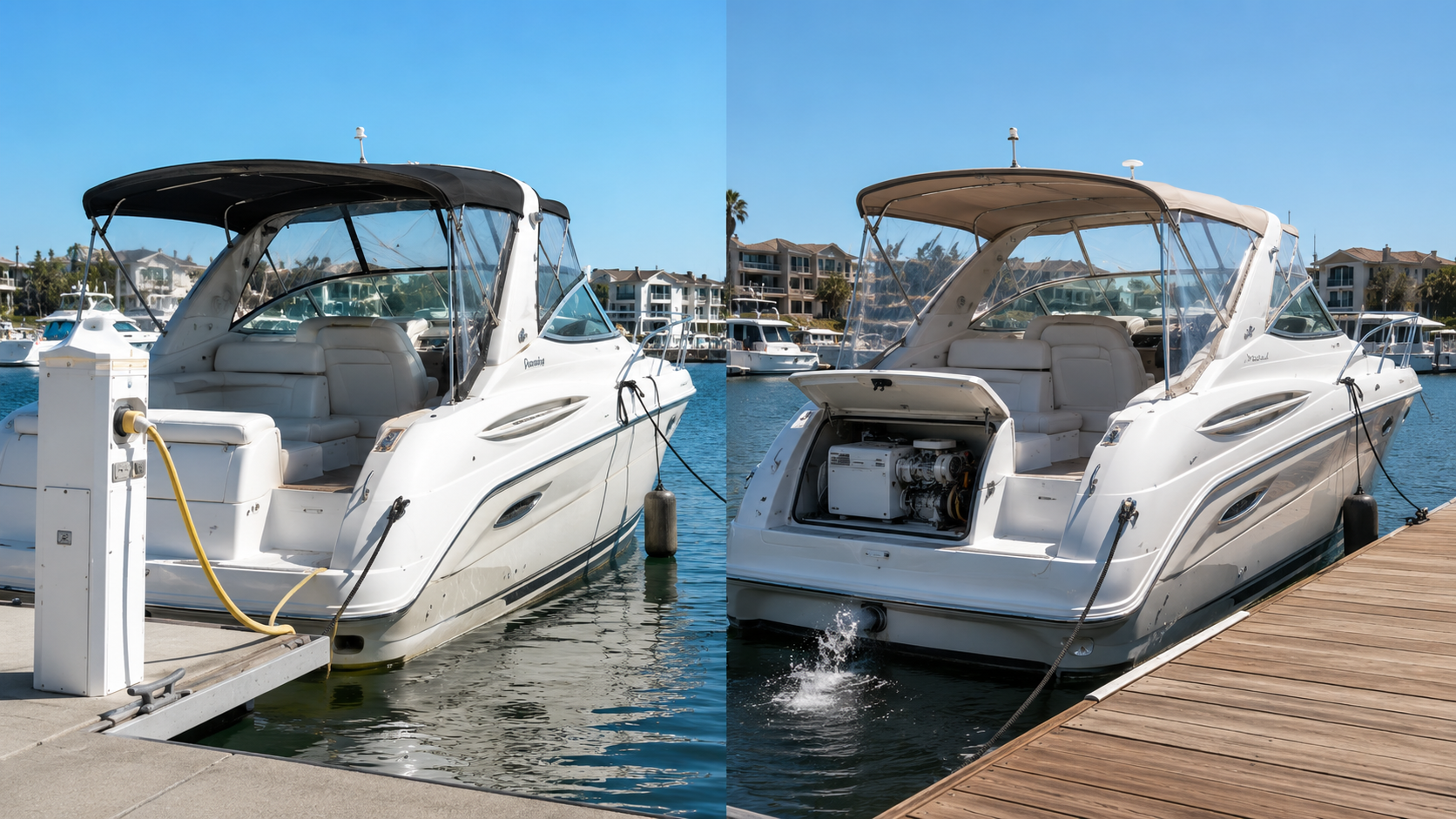
Shore power is generally the most convenient option when living in the boat slip, out just for the day, or staying over for the weekend. You receive efficient, dependable power that doesn’t require running a generator at all times for powering up the lights, charging the battery, refrigeration, or just onboard comfort. Generators still serve their purpose, but the daily problems in the marina can be solved in a smarter way with the use of shore power.
This guide distinguishes between the actual pros of choosing power from shore solutions or a generator and how they can be utilized by both boat owners and dock users for reduced noise pollution, increased convenience, safer docks, and more reliable power at the slip.
What is Shore Power?
Shore power connects your boat to a marina’s electrical system through a power pedestal. By plugging into the marina’s grid, you can run your boat’s electrical systems without the need for onboard generators or batteries.
Two numbers decide most of it: 30 amp and 50 amp. A 30-amp hookup at 120 volts is about 3,600 watts, which runs your lights, fridge, charger, and one air conditioner if you aren’t asking it to do much else. Step up to 50 amps at 120/240 volts, and you get roughly 12,000 watts, enough for a bigger boat running two or three AC units. Here’s the part nobody warns you about. That 3,600 watts is the rating, not always what reaches the boat. On a long dock run with a tired cord, voltage sags, and the AC is the first thing to complain. If your breakers keep tripping when the microwave and the air kick on together, you’ve outgrown 30 amp.
One habit worth picking up from years of watching boaters at the fuel dock: carry adapters. Not all of the marinas have a 50 amp service, and a boat pulling in with 50 amp service at a 30 amp space is a rough night without the proper pigtail.
Our power pedestals are designed to provide seamless shore power connections. This ensures that your boat is powered efficiently and safely. With their durable design and customizable options, our power pedestals allow you to enjoy all the benefits of shore power without the hassle of managing generators or fuel. They also come equipped with additional features like water hookups and lighting to enhance your marina experience.
What is Generator Power, and When Do You Actually Need It?
Generator power involves using an onboard or portable generator to produce electricity independently of shore facilities. While generators offer flexibility, they come with significant drawbacks. This is especially true when compared to shore power. Built-in gensets wire into your panel and put out real muscle, usually 5 to 20 kW. That’s the appeal. It’s also the catch.
A genset is an engine, and engines want attention. Oil changes every hundred-odd hours. A raw-water impeller that needs swapping before it shreds. Diesels especially hate idling under light loads, so firing one up just to charge a phone is a slow way to gum it up. Add fuel, add noise, add the smell that drifts back into the cockpit, and you start to see why more power was never free.
Then there’s the thing people skip past: carbon monoxide. A generator’s exhaust is invisible, and it has killed boaters, usually on swim platforms or while rafted up tight against another boat running its own genset. If you own a generator, a working CO alarm is not optional.
Advantages of Generator Power:
- Flexibility: Generators can be used in remote locations where shore power isn’t available.
- High Power Output: Generators can meet high energy demands, making them useful for large vessels or extensive electrical needs.
So who really needs one? People who anchor out for days, cruise long distances between marinas, or run heavy loads far from any dock. If that’s how you boat, a generator earns every dollar. If you’re tied up most weekends, it’s four or five thousand dollars installed, sitting in the bilge waiting to be serviced.
Why Shore Power Outshines Generator Power
If generators are more powerful and more flexible, why choose power pedestals over them? There are three main reasons why shore power is the clear choice for most boaters. Their cost efficiency, reliability, and environmental friendliness let them stand apart from their competition. Let’s talk more about these attributes.
1. Cost Efficiency
Shore power is far more economical in the long run. You eliminate fuel costs, maintenance fees, and the need for constant repairs that come with generator use. Power pedestals offer a straightforward, affordable connection to the marina’s power grid. All you need to do is pay a small fee to have access to the equipment. All of the maintenance is their responsibility.
2. Convenience and Reliability
Power pedestals provide a steady, reliable source of power. Unlike generators, which can run out of fuel or break down, shore power through power pedestals ensures that your boat is always powered without extra effort. Like gas stations, all you need to do when your power is running low is find a place to charge up. Most marinas across the country have the hookups you need, so it’s a dependable way to have power.
3. Environmental Responsibility
Shore power produces fewer emissions than generators, making it the greener choice. By plugging into marina power pedestals, you reduce both air pollution and noise.
There is one thing to consider: shore power is only available at marinas equipped with electrical hookups. If you venture into remote areas, it may not be accessible. But for the average boater, this shouldn’t be an issue.
The Quiet Third Option
There’s a middle path that the old shore power vs generator argument tends to ignore. A lithium (LiFePO4) battery bank paired with an inverter can run your loads in dead silence, then refill from shore power at the slip or from the engine while you’re underway.
Many owners are now using it to reduce the operating time of their generator to near zero or bypass the generator altogether. An inverter will cost about $1,500 for a 3000-watt unit. Your money goes into the battery bank, but you never put oil in it, nor does it stir up the boat trailer two slips away.
The majority of well-sorted vessels are on shore power at the dock for day-to-day operation and charging, batteries and an inverter for quiet, undisturbed nights at anchor and finally a generator if they really go “underground”.
Setting Up Shore Power So It’s Actually Safe

This is where the dock earns its keep, and where a lot of older marinas come up short. A good pedestal is more than a plug on a post. The shore power solutions that actually protect you have the right breakers, ground fault protection (ELCI or GFCI), and clean, corrosion-resistant connections that hold up in salt air.
That ground fault protection matters more than most boaters realize. Electric shock drowning occurs when stray current flows into the water around a dock and can be particularly dangerous in freshwater marinas, as seawater provides a more effective protection against current spreading around a swimmer’s body. A pedestal wired to trip on a fault is the cheapest life insurance on the dock. On the boat side, a galvanic isolator and a correctly wired inlet keep reverse-polarity and corrosion problems from quietly eating your hardware.
This is the part we deal with every day. Dock Boxes Unlimited builds marine power pedestals and stocks the power pedestal parts that keep them current and code-compliant, whether you’re wiring a single slip or running power across a whole marina.
If you want the full case for plugging in, our rundown on the benefits of shore power covers the rest. For power from shore solutions built to take salt, sun, and constant traffic, the gear on the dock is the part owners forget about until the day it fails.
Why Choose Dock Boxes Power Pedestals?
Our power pedestals are durable, reliable, and easy to use. Whether you’re outfitting a small dock or a large marina, our power pedestals offer the perfect shore power solution. With customizable options, you can ensure that your setup meets your specific needs. Our pedestals provide safe and secure connections to the marina’s electrical grid. That way, you and your guests have peace of mind as you enjoy your time on the water.
So, Which Is Best – Shore Power vs Generator?
For most people reading this, shore power is without much debate. It costs less to run, it makes no noise, and the only upkeep is owning a decent cord. Get a 50-amp slip if your boat needs the headroom. Add a battery and an inverter if you like quiet nights away from the dock. Buy a generator only if you genuinely live off it. Match the system to how you actually use the boat, then put it on dock equipment that won’t quit on you.
If you’re planning a new setup or upgrading a marina, contact Dock Boxes Unlimited, and we’ll help you spec the right shore power solution.
Frequently Asked Questions
How is shore power different from a generator?
Shore power is supplied from the dock and requires a plug from a power pedestal to the boat, where you draw electric current directly from the marina’s electrical grid. With this option, there’s no fuel, little noise, and virtually no maintenance. A generator uses diesel or gas and is portable, which means it can be used anywhere, including at anchor, and requires paying for fuel and servicing and managing its exhaust.
What voltage is shore power for boats?
In the US, recreational shore power is 120 volts on a 30-amp hookup or 120/240 volts on a 50-amp hookup. Thirty amps supplies approximately 3,600 watts, sufficient to power lights, a refrigerator, a battery charger, and one air conditioner. For larger boats using multiple ACs, that’s about 12,000 watts or so, and this increases at 50 amps per unit. Larger yachts and commercial vessels may require their services to be higher, and yachts built for use in Europe typically operate at 230 volts at 50 Hz—so if you are importing a hull, it might require a 230 volt 50 Hz to 110 volt 60 Hz converter.
Is shore power the same as shore power solutions?
Not exactly, even though the terms get mixed up. Shore power is the electricity itself, the power your boat draws from the dock. Shore power solutions is the bigger picture: the pedestals, breakers, wiring, metering, and parts that deliver that power safely. Think of it this way. Shore power is what you plug into. Shore power solutions are how a marina builds and maintains the system behind the plug. If you’re outfitting slips, the solution side is the part that keeps boats powered and people safe.
How much does shore power cost for boaters at a marina?
It depends on the marina, but it almost always beats running a generator on fuel. Marinas usually bill it one of three ways. Some include electricity in the slip fee for 30-amp service and add a charge for 50-amp. Some meter it by the kilowatt-hour at or just above the local utility rate. Others set a flat daily fee, often somewhere around $5 to $15 a night for 30 amp and higher for 50 amp. Liveaboards and seasonal slips tend to get metered, since that tracks real usage. Whatever the method, you skip the fuel and maintenance a generator piles on.
What equipment do marinas need to offer shore power?
The process begins with the power pedestals, where boat owners plug in their boats. A well-designed pedestal will provide correct receptacles for 30-amp and 50-amp boats, along with circuit breakers and either ground fault circuit interrupters (GFCI) or equipment leakage current interrupters (ELCI). On the other side of the pedestals, the marina requires the installation of marine wiring and feeder circuits suitable for the load, grounding and bonding of the system, as well as a method of metering electricity usage. Metering at a distance can be useful because of its ability to help avoid manual reading of the meters.